TYNTESFIELD HOUSE Artist Application
When I read of the call out for works in the neo-gothic style for Tyntesfield House, my thoughts were drawn to a postcard I owned of a lime-wood carving by Thomas Wilkinson Wallis (1821–1903). This carving, of three game birds, made in 1853, showed the creatures hanging from a branch, post mortem (below).

I recently took a career break to study Creative Arts Practise at Bath Spa University. I specialised in sculpture and found myself focused on carving wood, in particular lime wood. I was mainly interested in religious carvings from Renaissance Germany, but the above piece held my attention.
Lime wood is an important material symbolically, as medieval communities in Germany would assemble beneath the Lime (Linden) trees to celebrate and dance, and also hold judicial meetings. It was believed that Lime trees would help unearth truths. Wilkinson Wallis had captured something of the birds, their forms, no longer living, but now held in wood in perpetuity (now at the V&A East Storehouse).
It occurred to me that you might rewrite the story, simply by inverting the piece. Instead of a memento mori, the carving could be seen in an emancipatory light. That life might go on. That the birds might combine their strength and ascend skyward with the branch trailing below them.

I approached the site visit to Tyntesfield House with this in mind, that and the gothicism of Mary Shelley; reanimating the dead, or a ghostly presence from the Castle of Otranto.
In the drawing room, I sought a place where it might be possible to place the glass display case that will contain the birds. I saw the fireplace on the right as you enter the building, and once I stood before it realised that my idea and this location had been waiting for each other. Above the fireplace, Anthony Gibbs stands with his gun and hunting dog.
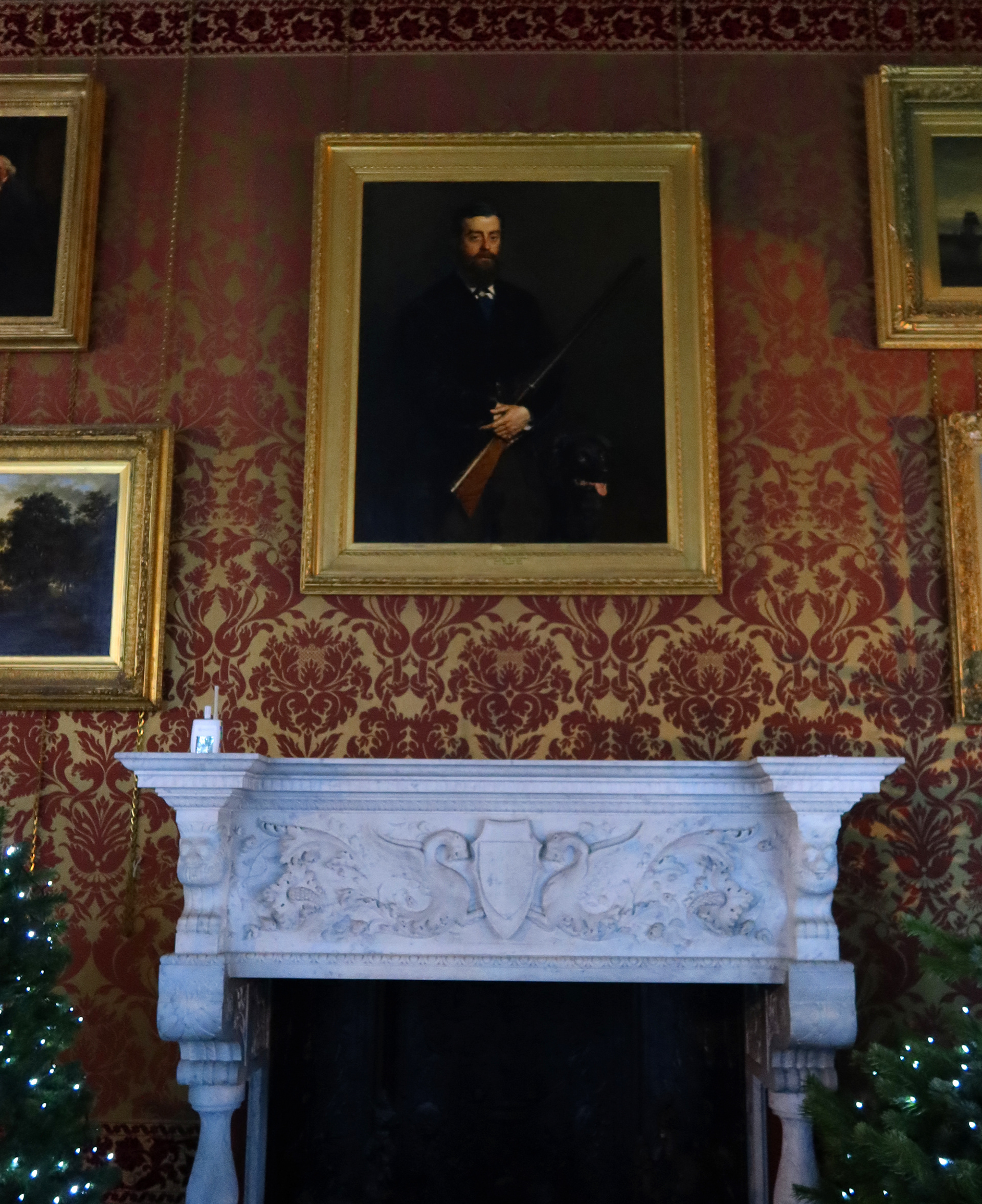
It was an uncanny feeling. I had sought a place to propose citing my birds, now free from the concerns of the living, and here it was, ironically in front of the person who might have shot at them when they were alive.

I wonder whether they should be carved as skeletons, or as they are. I would propose sourcing a glass display case that sits well with the room. I would not carve the piece from one block, rather in discrete components. To reiterite, I feel this project would be an ideal meeting of my practice with the location. It would refer to art of the past, and with a contemporary twist. It would also be an uplifting thing to behold, the hunted in ascendence before the hunter. Almost a religious thing.
The final form of the sculpture might develop with discussion. If the desired object were to be less archival and more artistic, the piece might consist of a enlarged woodcock skull, carved to rest at an angle on the fireplace, weighted to mirror the gun held in the painting behind.
